欢迎访问《农学学报》,

农学学报 ›› 2026, Vol. 16 ›› Issue (3): 1-9.doi: 10.11923/j.issn.2095-4050.cjas2025-0010
• 农艺科学 生理生化 • 下一篇
孙露宏( ), 黄姝涵, 艾琳, 刘旭
收稿日期:2025-01-09
修回日期:2025-05-14
出版日期:2026-03-20
发布日期:2026-03-19
作者简介:孙露宏,女,1992年出生,黑龙江通河人,工程师,硕士,主要从事环境、食品和农产品的质量与营养研究。通信地址:154000 黑龙江省佳木斯市桦川县东丞商贸9楼 农业农村部稻米及加工品质量与营养检验测试中心(桦川),Tel:0454-3821008,E-mail:1018996944@qq.com。
基金资助:
SUN Luhong(), HUANG Shuhan, AI Lin, LIU Xu
Received:2025-01-09
Revised:2025-05-14
Online:2026-03-20
Published:2026-03-19
摘要:
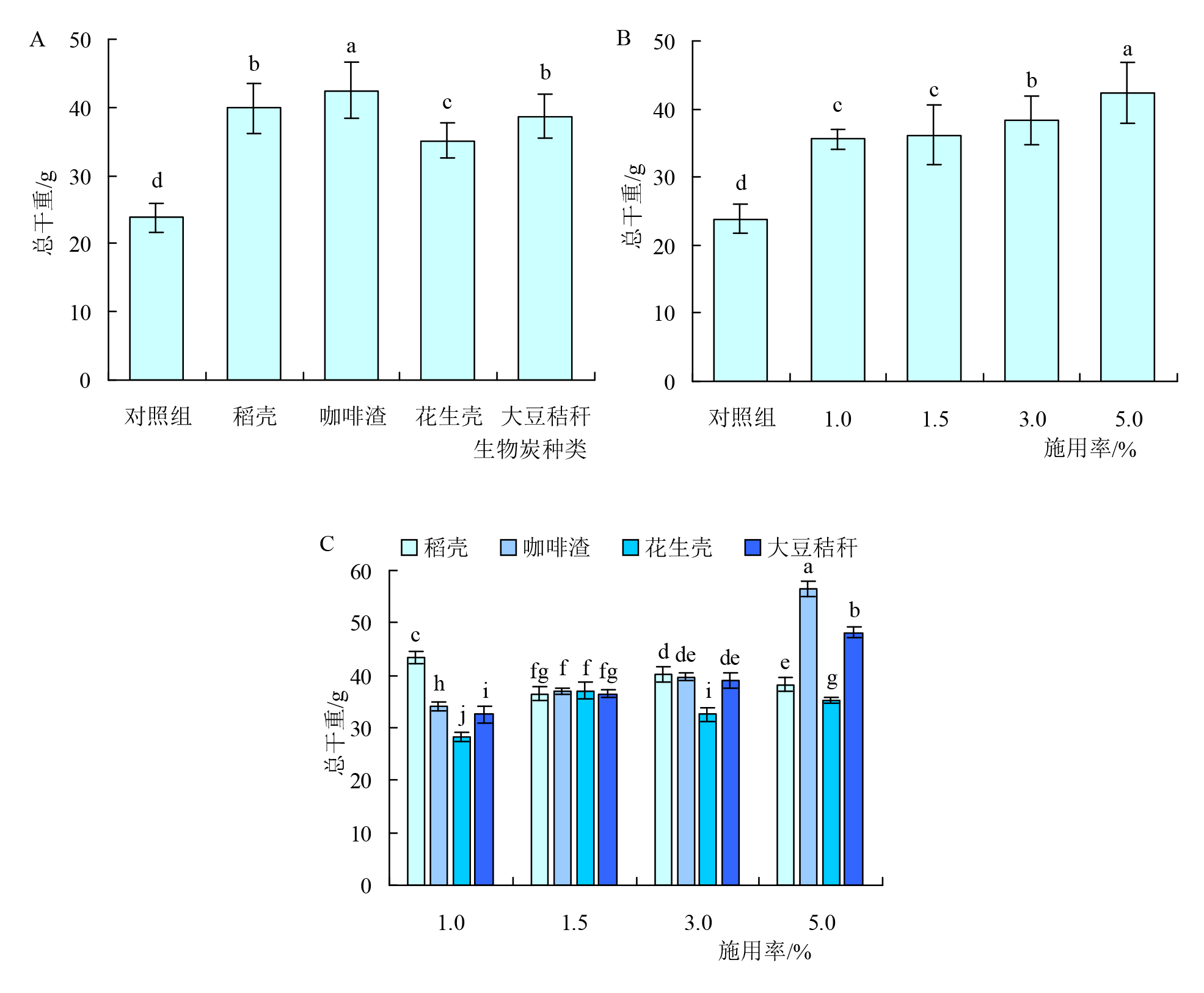
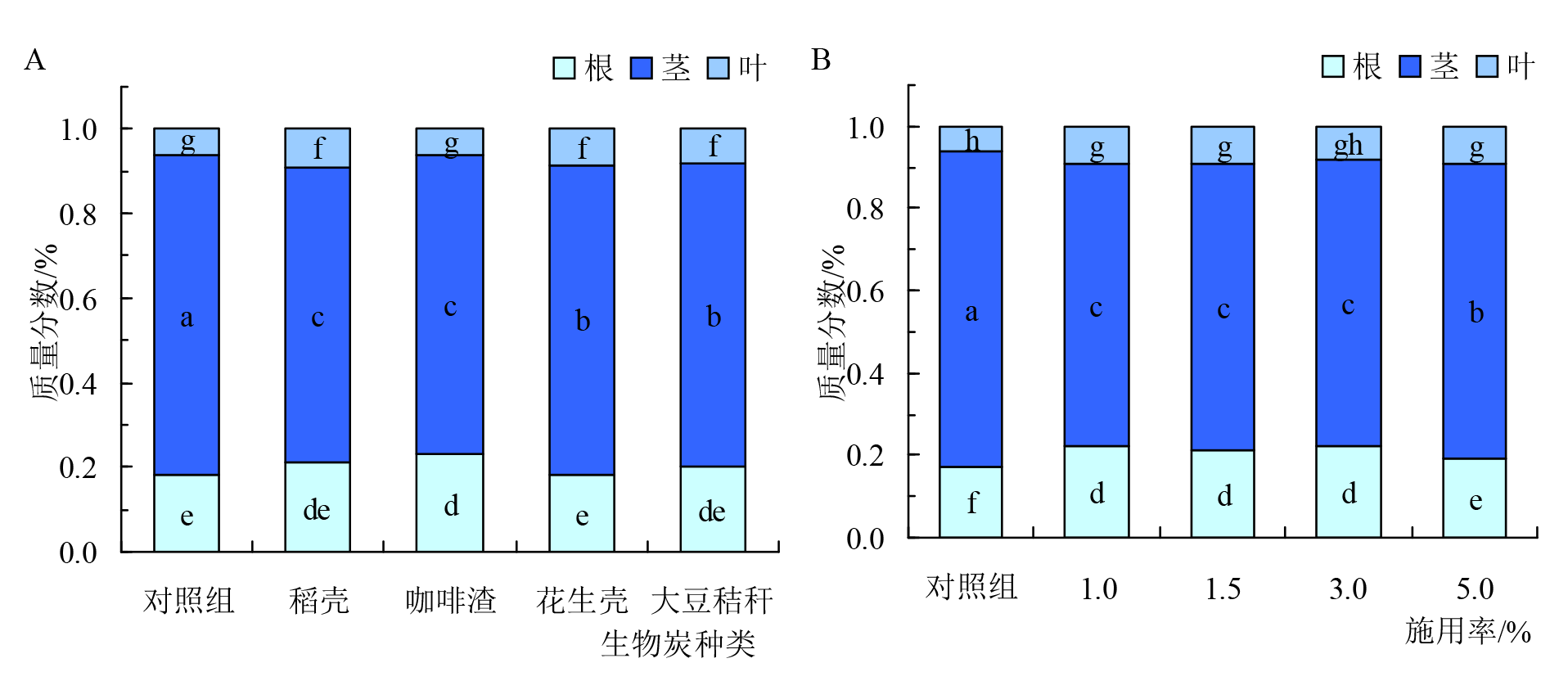
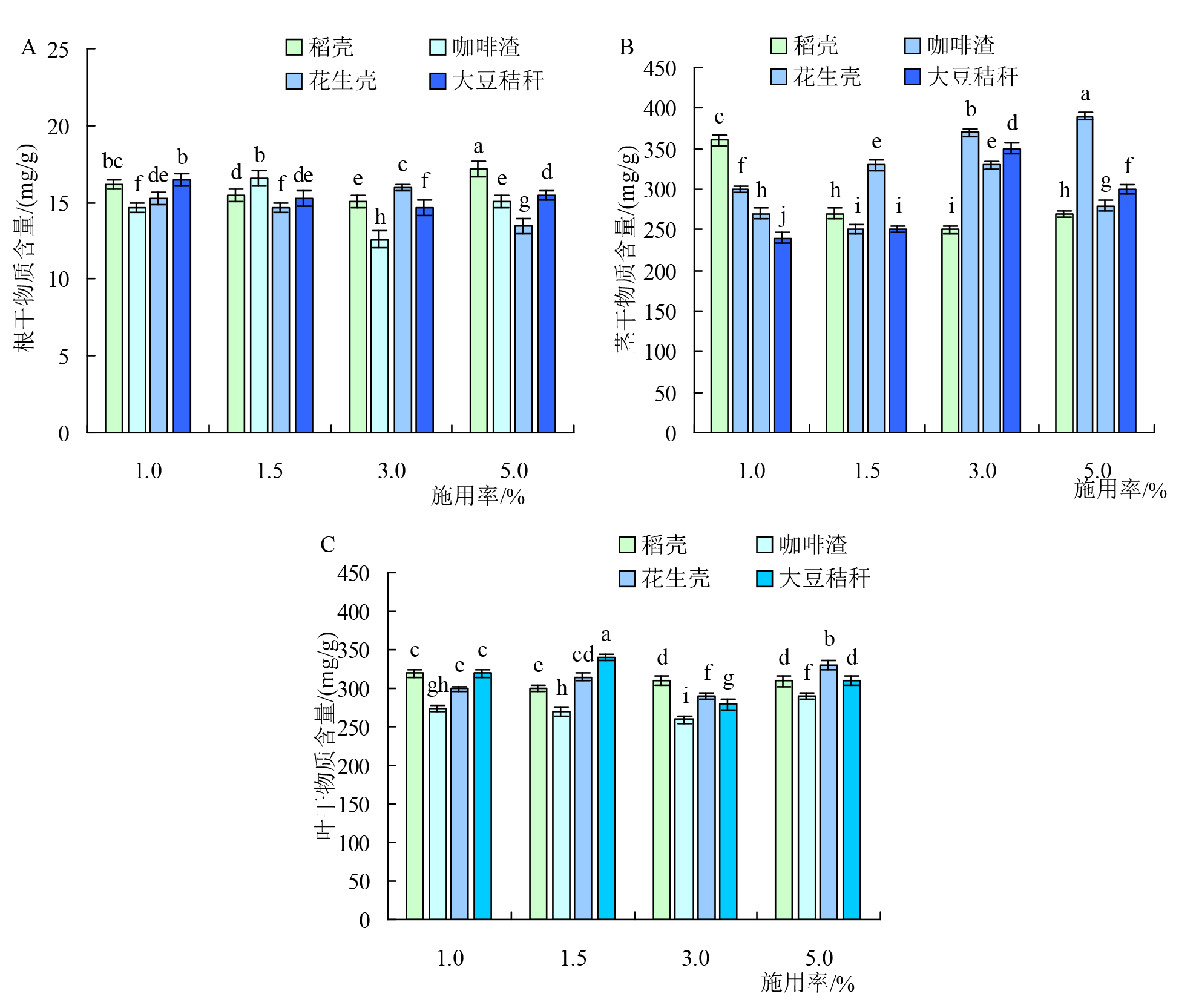
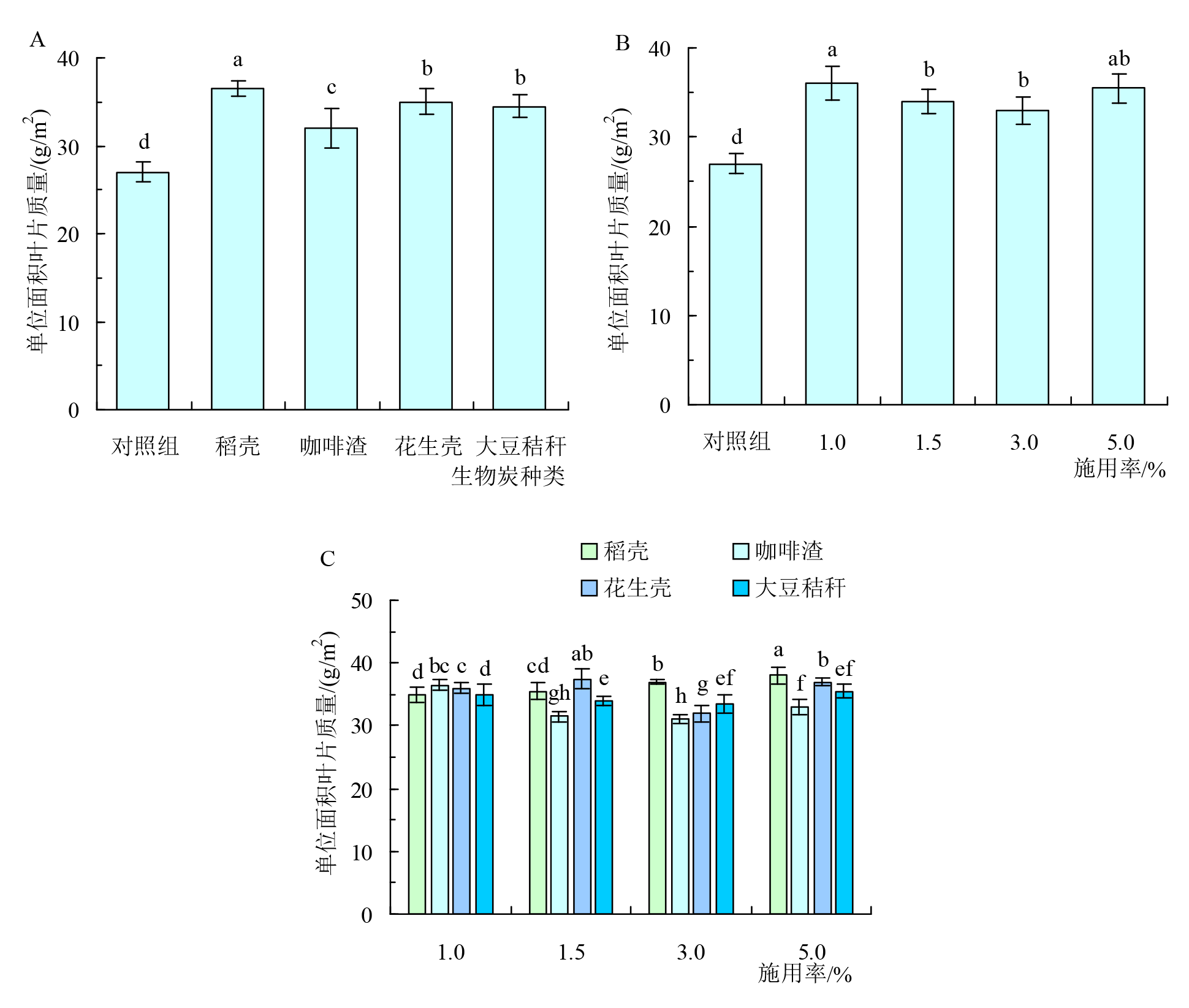
为明确生物炭种类及施用率对水稻生长的影响机制并优化其田间应用,本研究以稻壳、咖啡渣、花生壳、大豆秸秆4种废弃物制备的生物炭为材料,设置0%~5.0%梯度施用率,分析其对水稻(Oryza sativa L.)生长发育的作用。结果表明:生物炭能明显促进水稻生长,总干重生物炭处理组较对照组平均提升70.3%,其中稻壳生物炭和咖啡渣生物炭在施用率为5.0%时产量最高。生物炭对水稻植株不同器官影响差异显著:叶质量分数普遍增加,茎和根质量分数相对稳定,而根干物质含量显著提升(如稻壳生物炭处理组增幅达7.8%);此外,所有生物炭均提高了单位面积叶片质量,表明其可能通过增强光合作用效率促进增产。研究表明,生物炭对水稻的促生效应受种类与施用率双重调控,需结合作物需求与土壤条件优化施用方案,以充分挖掘其在绿色农业中的可持续应用潜力。
孙露宏, 黄姝涵, 艾琳, 刘旭. 不同生物炭种类和施用率对水稻生长特性的影响[J]. 农学学报, 2026, 16(3): 1-9.
SUN Luhong, HUANG Shuhan, AI Lin, LIU Xu. Effect of Different Biochar Species and Application Rates on Growth Characteristics of Rice[J]. Journal of Agriculture, 2026, 16(3): 1-9.
| 生物炭种类 | 施用率 | 生物炭种类×施用率 | 对照组与处理组 | |
|---|---|---|---|---|
| 根干重 | <0.0001*** | 0.035 | 0.0315 | <0.0001*** |
| 茎干重 | 0.0527 | 0.0001*** | 0.0012** | 0.0018** |
| 叶干重 | 0.0112** | <0.0001*** | 0.0016** | 0.0015** |
| 总干重 | 0.0028** | <0.0001*** | 0.0017** | 0.0001*** |
| 生物炭种类 | 施用率 | 生物炭种类×施用率 | 对照组与处理组 | |
|---|---|---|---|---|
| 根干重 | <0.0001*** | 0.035 | 0.0315 | <0.0001*** |
| 茎干重 | 0.0527 | 0.0001*** | 0.0012** | 0.0018** |
| 叶干重 | 0.0112** | <0.0001*** | 0.0016** | 0.0015** |
| 总干重 | 0.0028** | <0.0001*** | 0.0017** | 0.0001*** |
| 生物炭种类 | 施用率 | 生物炭种类×施用率 | 对照组与处理组 | |
|---|---|---|---|---|
| 根质量分数 | 0.2401 ns | 0.0055** | 0.0051** | 0.7542 ns |
| 茎质量分数 | 0.5226 ns | 0.0706 ns | 0.0080* | 0.1443 ns |
| 叶质量分数 | 0.0007** | 0.0485* | 0.0279** | <0.0001*** |
| 生物炭种类 | 施用率 | 生物炭种类×施用率 | 对照组与处理组 | |
|---|---|---|---|---|
| 根质量分数 | 0.2401 ns | 0.0055** | 0.0051** | 0.7542 ns |
| 茎质量分数 | 0.5226 ns | 0.0706 ns | 0.0080* | 0.1443 ns |
| 叶质量分数 | 0.0007** | 0.0485* | 0.0279** | <0.0001*** |
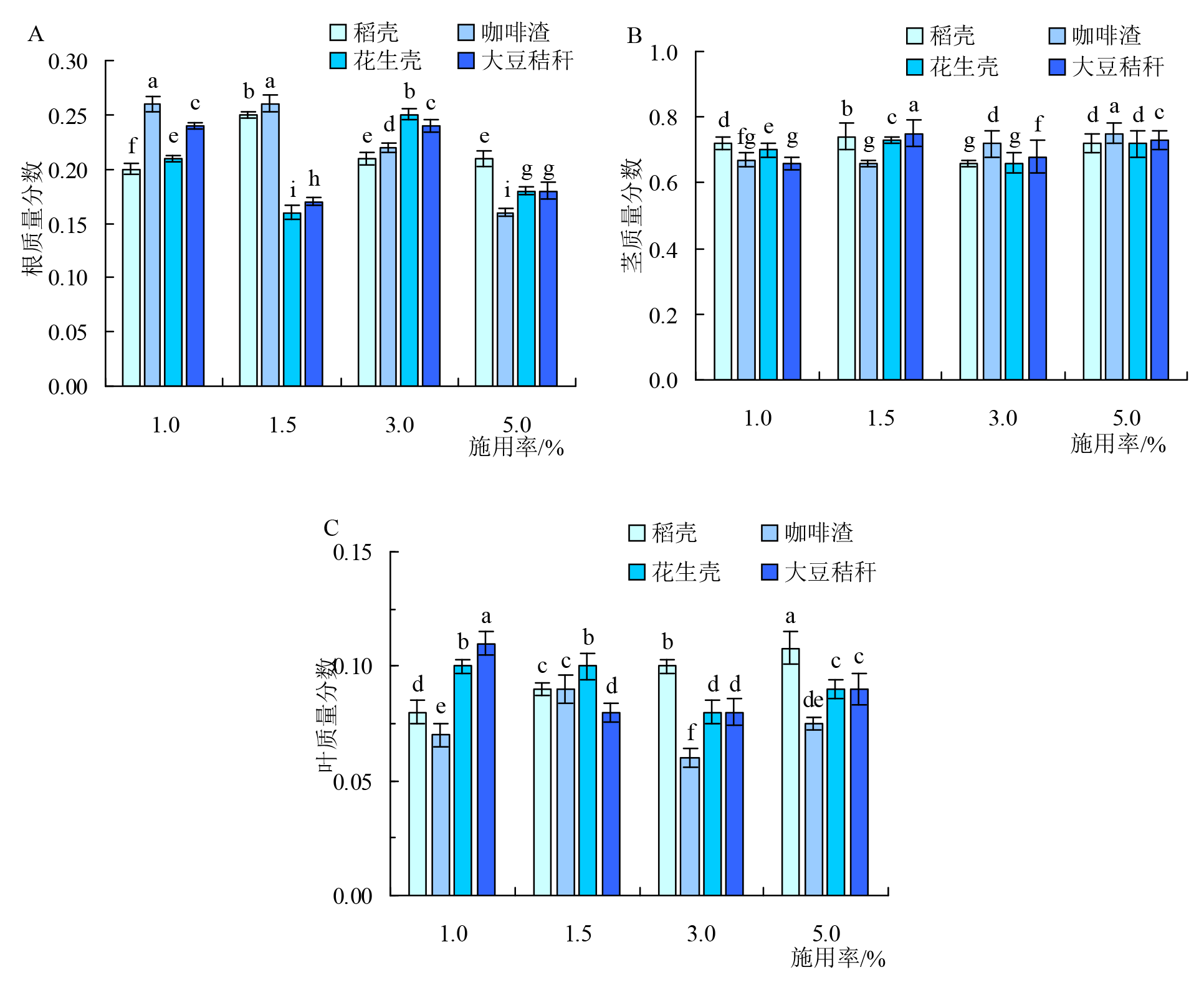
| 生物炭种类 | 施用率 | 生物炭种类×施用率 | 对照组与处理组 | |
|---|---|---|---|---|
| 根干物质含量 | 0.0241 | 0.0455 | 0.0016** | 0.0003* |
| 茎干物质含量 | 0.1235 ns | 0.001** | <0.0001*** | 0.4275 ns |
| 叶干物质含量 | 0.0331 | 0.2676 ns | 0.5924 ns | <0.0001*** |
| 单位面积叶片质量 | 0.2117 ns | 0.5123 ns | 0.8759 ns | <0.0001*** |
| 生物炭种类 | 施用率 | 生物炭种类×施用率 | 对照组与处理组 | |
|---|---|---|---|---|
| 根干物质含量 | 0.0241 | 0.0455 | 0.0016** | 0.0003* |
| 茎干物质含量 | 0.1235 ns | 0.001** | <0.0001*** | 0.4275 ns |
| 叶干物质含量 | 0.0331 | 0.2676 ns | 0.5924 ns | <0.0001*** |
| 单位面积叶片质量 | 0.2117 ns | 0.5123 ns | 0.8759 ns | <0.0001*** |
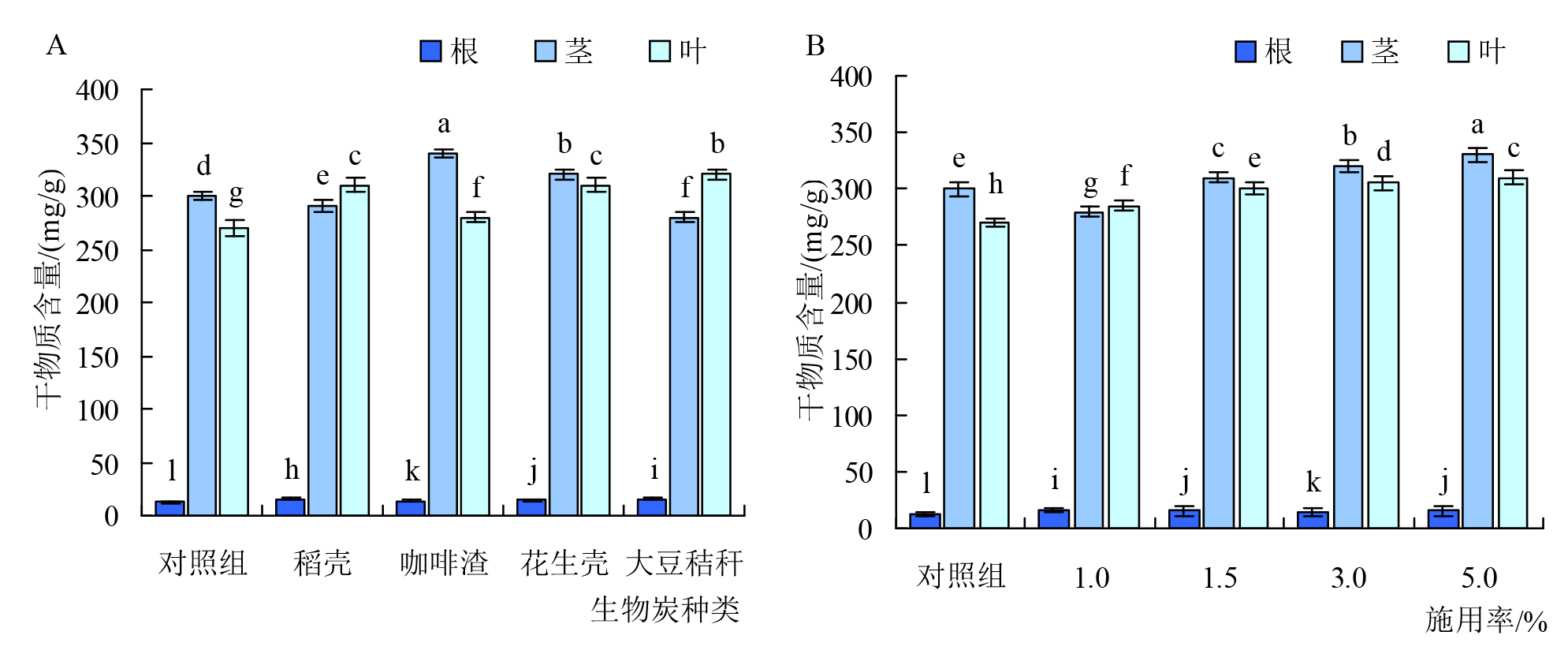
| [1] |
|
| [2] |
doi: 10.1007/s42773-023-00207-z |
| [3] |
doi: 10.1016/j.psep.2022.05.056 URL |
| [4] |
doi: 10.1007/s42773-022-00137-2 |
| [5] |
doi: 10.3390/su13031318 URL |
| [6] |
doi: 10.1038/s41598-022-05757-z |
| [7] |
doi: 10.1038/s41561-021-00852-8 |
| [8] |
doi: 10.1039/C7RA10353K URL |
| [9] |
doi: 10.1007/s11104-015-2700-5 URL |
| [10] |
doi: 10.1007/s13593-015-0343-9 URL |
| [11] |
doi: 10.1038/s41598-022-22149-5 pmid: 36481749 |
| [12] |
doi: 10.1038/srep10001 |
| [13] |
doi: 10.1038/s41467-017-01123-0 pmid: 29057875 |
| [14] |
|
| [15] |
doi: 10.1016/j.scitotenv.2018.03.380 URL |
| [16] |
doi: 10.1016/j.ejsobi.2021.103298 URL |
| [17] |
doi: 10.1016/j.jssas.2021.07.005 URL |
| [18] |
doi: 10.1111/gcbb.2017.9.issue-10 URL |
| [19] |
doi: 10.1111/jec.2019.107.issue-2 URL |
| [20] |
doi: 10.1071/BT12225 URL |
| [21] |
doi: 10.1093/aob/mcw022 pmid: 27017586 |
| [22] |
doi: 10.1088/1755-1315/648/1/012182 |
| [23] |
doi: 10.1016/j.scitotenv.2020.144769 URL |
| [24] |
doi: 10.1007/s42729-020-00390-z |
| [25] |
doi: 10.1007/s11368-020-02846-2 |
| [26] |
doi: 10.1111/j.1469-8137.2011.03952.x pmid: 22085245 |
| [27] |
doi: 10.1111/jec.2011.99.issue-3 URL |
| [28] |
doi: 10.1016/j.chemosphere.2020.129458 URL |
| [29] |
doi: 10.1002/jpln.v177.1 URL |
| [30] |
|
| [31] |
doi: 10.3390/agronomy13061522 URL |
| [1] | 孙计平, 吴照辉, 李雪君, 孙焕, 韦凤杰. 生长调节剂对低温胁迫烟草的缓解效果[J]. 农学学报, 2026, 16(3): 16-20. |
| [2] | 李效珍, 李睿, 李子龙, 李小强, 王嘉媛, 梁丽珍. 不同灌溉方式下黄花菜生长发育与产量的对比分析[J]. 农学学报, 2026, 16(3): 40-50. |
| [3] | 李哲, 李广, 周晨莉, 张恒嘉. 膜下滴灌马铃薯调亏灌溉的研究进展[J]. 农学学报, 2026, 16(2): 54-58. |
| [4] | 张玲, 彭婵, 郭赟, 唐岚, 王文武, 丰文清, 陈慧玲. 生根培养基对药用石斛组培苗生根及生长的影响[J]. 农学学报, 2026, 16(2): 74-78. |
| [5] | 于子涵, 韩熙, 吴晓玲, 肖光莉, 王盈, 陈玉红. 川东南地区不同水稻品种镉转运积累特征研究[J]. 农学学报, 2026, 16(1): 48-56. |
| [6] | 王秋京, 马国忠, 姜丽霞, 初征, 余兰, 闫平. 新气候态下夏季热量资源变化对寒地水稻生育期和产量的影响[J]. 农学学报, 2026, 16(1): 90-98. |
| [7] | 张君莉, 王瑶, 夏琼梅, 朱海平, 龙瑞平, 李贵勇, 邓安凤, 杜晨晴, 杨从党. 氮肥运筹对‘超优千号’产量和产量构成因素的影响[J]. 农学学报, 2025, 15(8): 23-29. |
| [8] | 张虎, 吴月娥, 段海燕. 水稻氮利用效率相关功能基因研究现状[J]. 农学学报, 2025, 15(8): 6-12. |
| [9] | 李建丽, 王思来, 邹书, 张海清, 相章嫩, 普伟, 张玉娇, 黄光福. 云南高光效常规水稻品种株型研究[J]. 农学学报, 2025, 15(6): 10-15. |
| [10] | 屈洋, 马雯, 刘晓婷, 薛玉莹, 余陇辉, 闫俊平, 王可珍. 播种深度与种衣剂对夏大豆幼苗生长、光合性能、产量和品质的影响[J]. 农学学报, 2025, 15(5): 1-6. |
| [11] | 张鹏, 杨旭昆, 陈璐, 王文治, 米艳华, 刘振环, 李茂萱, 苏雯, 王相全, 杨彦雄, 郭陆军. 有机种植和常规种植对云南水稻品质和经济效益影响研究[J]. 农学学报, 2025, 15(5): 12-19. |
| [12] | 刘磊, 李薇, 李争艳, 高本旺, 黄成名, 张海玲. 植物生长调节剂对三叶木通扦插生根的影响[J]. 农学学报, 2025, 15(5): 80-84. |
| [13] | 张彦, 陈京都, 辛海滨, 刘翠莲, 徐瑞衡, 范晓凯, 王颖. 侧深减氮施肥条件下硅肥和锌肥对水稻产量及抗倒性的影响研究[J]. 农学学报, 2025, 15(4): 7-12. |
| [14] | 朱雨晴, 李华昭. 鱼台水稻光温模型研究与产量预报[J]. 农学学报, 2025, 15(4): 83-91. |
| [15] | 张会, 颜蕙园, 施娅颖, 赵娜娜. 河南省南部某县水稻籽粒重金属污染特征及健康风险评价[J]. 农学学报, 2025, 15(2): 22-26. |
| 阅读次数 | ||||||
|
全文 |
|
|||||
|
摘要 |
|
|||||
